TL;DR: We took 2,744 App Store releases from May 6 to September 28, 2026 and counted new top-10 keywords for each app in the 21 days before and after the release. In the three weeks after the release, 35.3% of apps picked up a new top-10 keyword. Before it, the rate was 29.2% (+6.1 points, 95% interval 4.3 to 8.0). The typical release moved nothing: the median was zero new top-10 keywords in both windows. The gains are lumpy, since the top 5% of releases account for 54% of all new top-10 keywords. A Keiki-style burst, meaning five or more new top-10 keywords after a quiet month, followed 1.3% of releases. It showed up in 0.8% of the comparison windows before a release.
The data is the US keyword position history in our own database. We started from a random sample of 65,362 apps. Of those, 26,377 shipped a version from March 10 to October 19. We kept apps whose release stood alone, with no second version inside 21 days on either side. That left 16,333. Of those, 5,238 ranked for at least 100 US keywords, and 2,744 releases met the crawl-coverage rule in the three windows we compare (details in the method notes). Our crawl logs a keyword position when it changes, so we measure what a release does to the number of keywords an app holds in the top 10 and top 50.
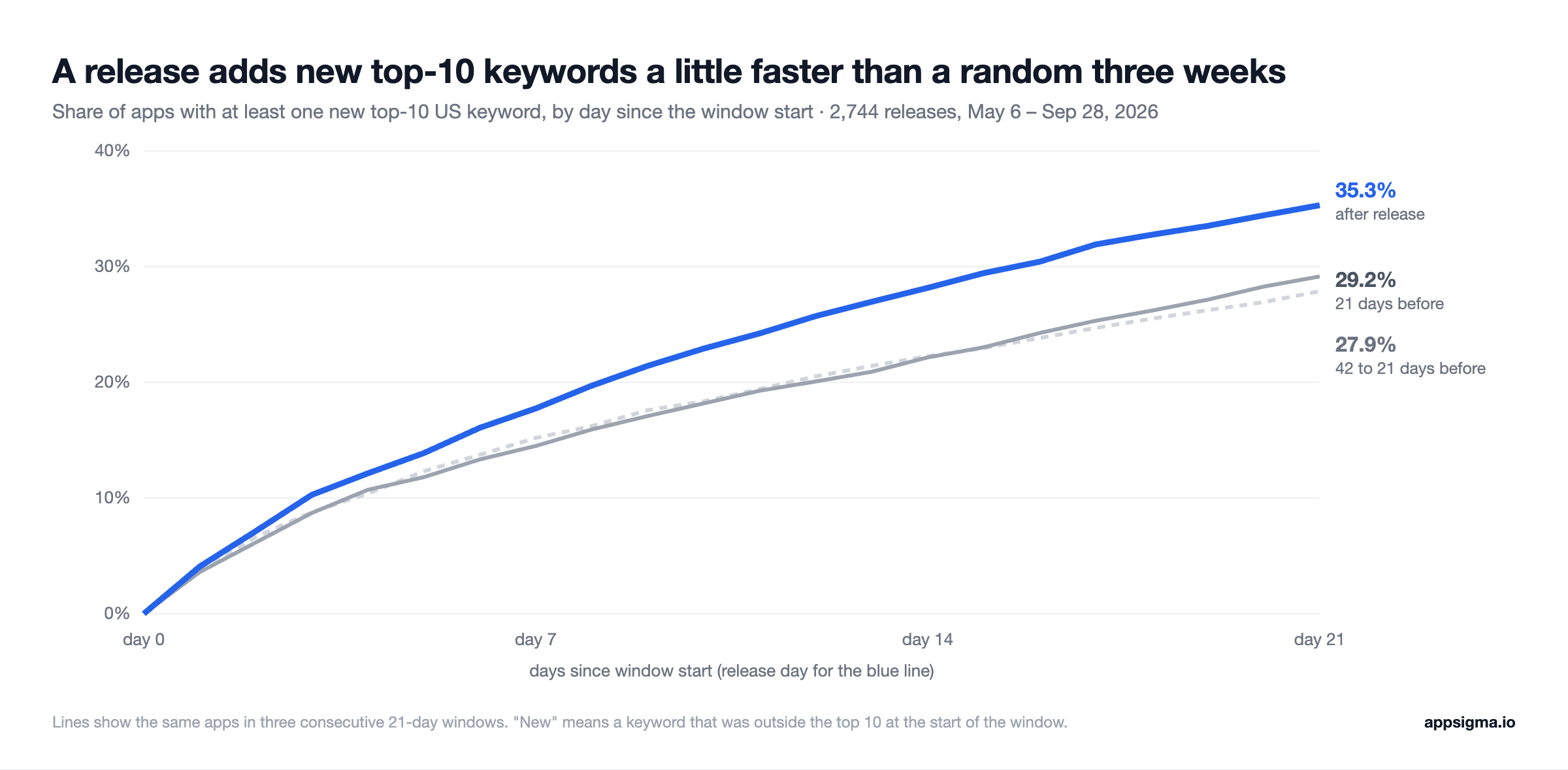
A release adds a new top-10 keyword for 6 more apps in 100
We counted a keyword as new when it sat outside the top 10 on the first day of a window and inside it on the last day. We ran the same count on three windows for each release:
| Window | Share of apps with a new top-10 keyword | Average gained in top 10 | Average gained in top 50 |
|---|---|---|---|
| Six to three weeks before | 27.9% | not measured | not measured |
| Three weeks before | 29.2% | 1.03 | 4.64 |
| Three weeks after | 35.3% | 1.25 | 6.00 |
The two windows before the release look alike, so a slow trend does not explain the step. Comparing the last two windows, a release gains +0.22 top-10 keywords on average (interval 0.11 to 0.34) and +1.36 top-50 keywords (interval 0.94 to 1.77). That is real, and it is small. Most of the "effect" of shipping a version is that the 21 days around it look like any other 21 days for the same app.
Six in ten releases changed nothing in the top 10
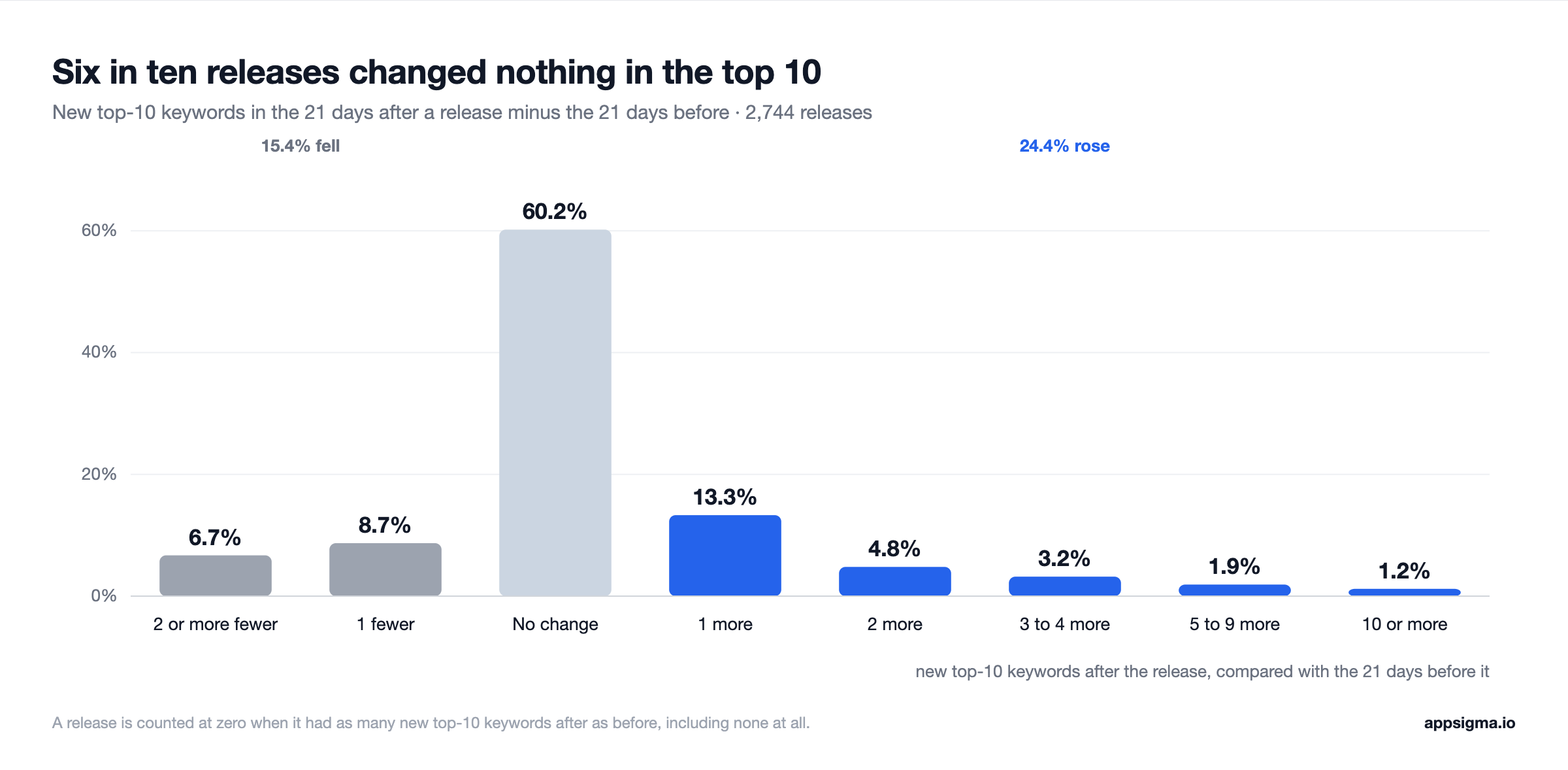
We subtracted each app's count of new top-10 keywords before the release from its count after it. 60.2% of releases came out at zero, 24.4% came out higher and 15.4% came out lower. A release is not a guarantee of anything, and rankings also fall after releases about as often as one in six times.
The percentiles show how thin the tail is:
| Percentile | Top 10, before | Top 10, after | Top 50, before | Top 50, after |
|---|---|---|---|---|
| Median | 0 | 0 | 1 | 2 |
| 75th | 1 | 1 | 5 | 6 |
| 90th | 2 | 3 | 11 | 15 |
| 95th | 5 | 5 | 19 | 24 |
| 99th | 17 | 18 | 45 | 57 |
The top 5% of releases hold 54% of the new top-10 keywords in the 21 days after, and the top 10% hold 71%. Averages hide this. If your own release adds three new top-10 keywords, you are already near the top 10%.
Bursts like Keiki are rare, and they happen without releases too
The Keiki case study showed an app climbing from rank 150 to 250 into the top 10 on dozens of searches within two weeks of a version that looked like a bug fix. We looked for the same shape across the sample: a release followed by at least five new top-10 keywords, after at most one before it.
| Burst size | After a release | Same test on the window before |
|---|---|---|
| 3 or more | 119 releases (4.3%) | 82 (3.0%) |
| 5 or more | 36 (1.3%) | 21 (0.8%) |
| 10 or more | 7 (0.3%) | 4 (0.1%) |
The ratio is about 1.5 to 1.7 times, which fits a modest release effect. It is not the 10-fold jump you might expect if every burst were a rewritten keyword field. Most bursts happen with no release in front of them. They come from something else, such as a growing rating count, a creative change that raised conversion, paid traffic, or another app dropping out of the results. Keiki itself is outside this sample: our crawl has a gap from March 13 to March 25, and the app shipped again 15 days after its March 30 release.
The first new keyword arrives about a week in, with or without a release
For the 969 releases that had a new top-10 keyword in the 21 days after, we measured how many days passed until the first one showed in our log:
| Window | 10th pct | 25th | Median | 75th | 90th | Within 7 days |
|---|---|---|---|---|---|---|
| After a release | 0.8 | 2.6 | 7.0 | 12.6 | 16.9 | 50.3% |
| Before a release (same test) | 0.8 | 2.4 | 7.0 | 13.8 | 18.0 | 49.8% |
The two rows are almost the same. If Apple processed a keyword change on a fixed delay, the first row would pile up at one point. It does not. New keywords arrive across the whole three weeks, at a steady pace, in both windows. So the data does not give one number for "how long Apple takes".
In the clear cases, the delay is short. Across the 36 bursts, the first new top-10 keyword appeared a median of 3.1 days after the release (interquartile range 1.7 to 6.6), and 81% showed one within a week. The 21 matching bursts before a release had a median of 3.6 days and 67% within a week. The gap is small, but the direction fits what we saw for Keiki: when a metadata change takes, it takes within days to two weeks.
An example: 0 to 14 top-10 keywords in three weeks, with nothing visible changed
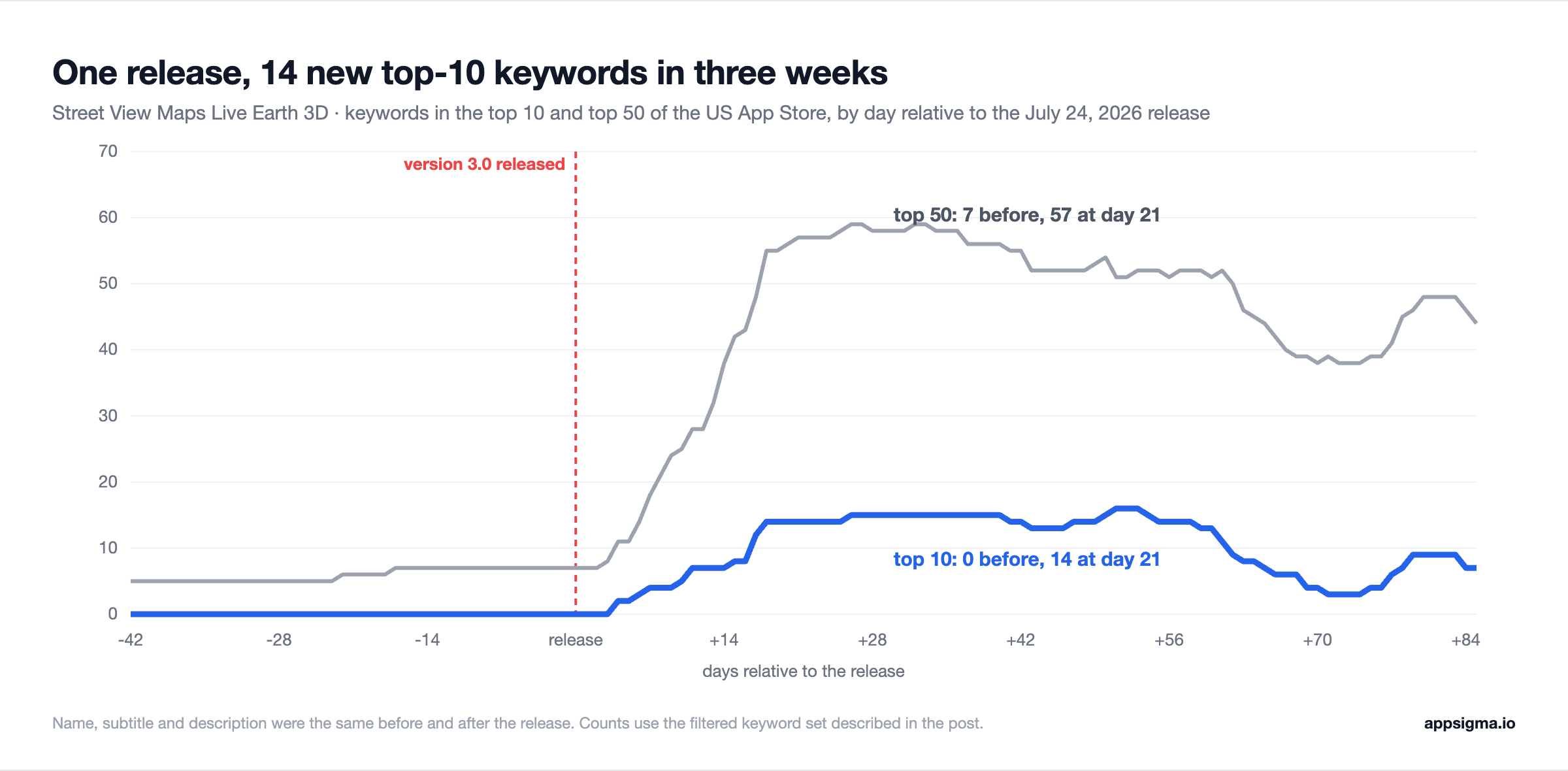
The app Street View Maps Live Earth 3D shipped version 3.0 on July 24 with the notes "Performance Improve, Fixed bugs, Improved UI/UX." Its name, subtitle and description were the same before and after. In the six weeks before the release it held no top-10 keyword and 5 to 7 in the top 50. Within five days the first top-10 keywords appeared. By day 21 it held 14 in the top 10 and 57 in the top 50.
Some of the moves: "usgs earth explorer" went from 164 to 9 within three days, "google maps live view" from 177 to 8 within nine days, "live view gps" from 77 to 10 within 11 days and "street view maps" from 58 to 3 within 17 days. The set held until about day 56, then slid back to 4 to 9 top-10 keywords by day 70. We cannot see this app's keyword field, so we cannot prove that the field changed. It is a case that matches that story and every other one we checked.
Releases that changed the name or subtitle showed a larger average jump, from a small group
We compared each release's snapshot with the previous snapshot we captured. The name or subtitle differed in 82 releases where the earlier snapshot was under 120 days old. In 2,466 releases both fields matched. For another 196 we could not tell (no earlier snapshot, a subtitle that appeared where we had none, or an older change we could not date).
| Group | Releases | Average gained, before | Average gained, after | Change (95% interval) |
|---|---|---|---|---|
| Name and subtitle unchanged | 2,466 | 1.05 | 1.24 | +0.19 (0.07 to 0.32) |
| Name or subtitle changed | 82 | 1.46 | 2.16 | +0.70 (0.13 to 1.37) |
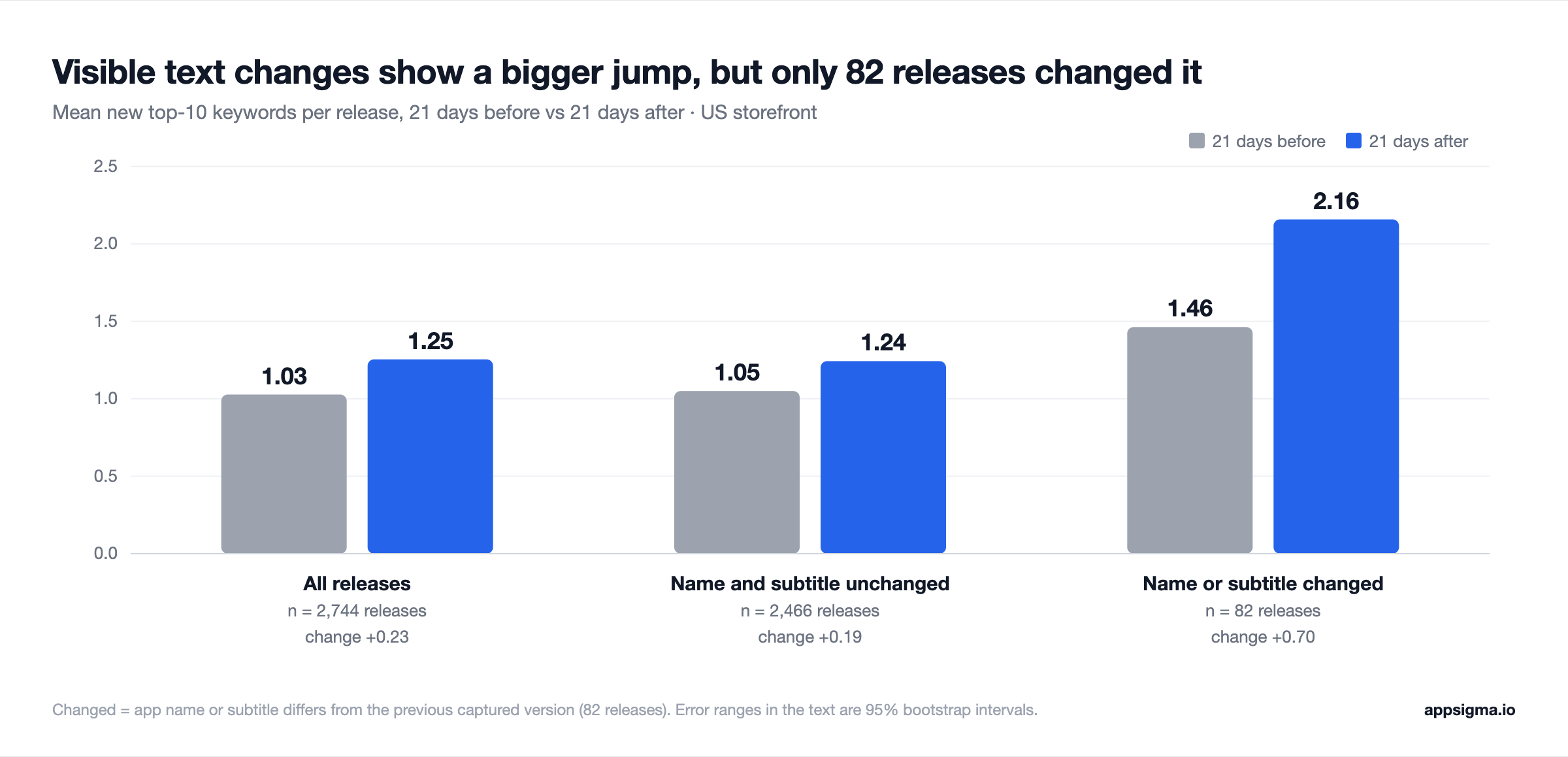
The unchanged group is the interesting one for the hidden keyword field. If a release with identical visible text still adds top-10 keywords, the likely source is that field. It does: 34.5% of those releases brought one, against 29.0% in the window before, a lift of +5.5 points (interval 3.5 to 7.5). It is almost the same lift as the whole sample, because that group is 90% of it. The changed group is too small to split further. Its share of apps with a gain barely moved (43.9% to 45.1%), and only the mean did. We read that as "visible text changes may add more, but 82 releases cannot show it."
By month, the lift is real in four months out of five
| Release month | Releases | Share with a gain, before | Share with a gain, after |
|---|---|---|---|
| May (from May 6) | 584 | 22.4% | 25.9% |
| June | 599 | 27.4% | 23.2% |
| July | 559 | 17.2% | 31.1% |
| August | 513 | 36.1% | 45.6% |
| September | 489 | 45.8% | 55.4% |
Two things show up. First, June is the exception, with a lower share after the release than before. Our crawl volume dropped in the second half of June, and a thinner crawl records fewer rank changes in the post window. Second, the base rate more than doubles from July to September, from 17% to 46% in the pre window. Part of that is seasonality in app searches and part is how often our crawler revisits keywords, so compare releases to their own before window, not to each other across months.
What to take from this
- Expect no change from a typical release. Six in ten show the same number of new top-10 keywords before and after. Treat a ranking jump as a bonus, not the plan.
- Measure against your own baseline. Roughly 29 apps in 100 gain a top-10 keyword in a random three weeks. Without the before window, you will credit your release for movement that was there already.
- A hidden keyword field release has a real, modest effect. Even releases with the same name, subtitle and description raised the odds of a gain by 5.5 points.
- Wait two to three weeks before judging. New keywords arrive steadily across 21 days, and bursts in our data had their first new keyword in a median of 3 days but their median new keyword at about 13 days.
- Check what else shipped. Creative tests, ratings and paid traffic all move rankings, and none of them is visible in a position log.
We covered how positions move without releases in how long a top-10 ranking lasts, and the mechanics of the position data in our guide to rank tracking. AppSigma tracks the keyword positions of your app and your competitors, so you can line each release up against the before and after yourself.
Method notes: US storefront only. Sample: a random 2% of apps (65,362). Release = a version's release date. We kept each app's first release between April 1 and September 28 that had no other release within 21 days before or after. Apps needed at least 100 US keywords ranked in the top 250. Final sample: releases dated May 6 through September 28 that have position changes logged on at least 5 distinct days in each of three 21-day windows (42 to 21 days before, 21 days before, 21 days after). We left out April because our crawl log has no data from March 13 to 25, which breaks the earlier window. Our log records a keyword only when its position changes, so a keyword with no row before a window counts as outside the top 250 only if the keyword existed before our log began on February 19. "New top-10 keyword" = outside the top 10 at the window start, inside at the window end. Keyword filter: we dropped keywords flagged junk by our own classifier (1,379 of 101,982 candidates) and then kept only keywords whose current US top 10 results mostly share a word with the keyword in their name or subtitle (at least half). That removes person names and other terms whose results are padded with unrelated apps, and kept 60,369 of the 101,982 candidates. Without the relevance filter the lift is +6.5 points (35.4% to 41.9%), at a 30% threshold +6.3 points and at 70% +5.4 points. Intervals are bootstrap intervals over releases. The sample over-represents apps that already rank widely. We cannot see the keyword field, nor can we measure A/B tests, ads or ratings for these releases. The days-to-first-keyword figures have the resolution of our crawl, which is a few days.
Frequently asked questions
How long does it take Apple to index a keyword change?
For apps that gained anything, the first new top-10 keyword showed up about a week after the release, and in the 36 clearest cases after about 3 days. Three-week windows with no release gave the same one-week figure, so most of that timing is background movement and not indexing delay.
Does a new app version improve App Store keyword rankings?
Slightly, on average. Across 2,744 releases, about 35 apps in 100 gained a top-10 keyword in the following three weeks, compared with about 29 in 100 in the three weeks before. In six of ten releases the count did not change at all.
Can you tell from rankings that someone changed the hidden keyword field?
Not for certain. When the name, subtitle and description stay the same and an app climbs on dozens of searches, the hidden field is the likeliest cause. But rating growth, creative tests, ad spend and rivals dropping out can produce the same pattern, and Apple does not expose the field.