
TL;DR: We followed Duolingo's US App Store page for 13 months, from September 15, 2025 to October 19, 2026. In that time Duolingo used 4 app names, 4 subtitles and 5 stunt icons. It also ran 9 product page A/B tests: on 61% of days between mid-September and late July, a test was live on its page. The screenshot set it had kept since at least September 2025 was replaced on August 3 by a set built from tested variants. The top annual Super Duolingo price listed on the store went from $95.99 to $119.99.
We captured Duolingo's listing (app id 570060128, US storefront) 67 times, about once a week, up to October 12, and read the live page again on October 19. Each capture stores the name, subtitle, description, icon, screenshots and in-app purchases. Our experiment detector logged every Product Page Optimization test that Apple served to our crawl sessions. The dates below are the first capture that showed each change, so a change can be up to a week older than its date.
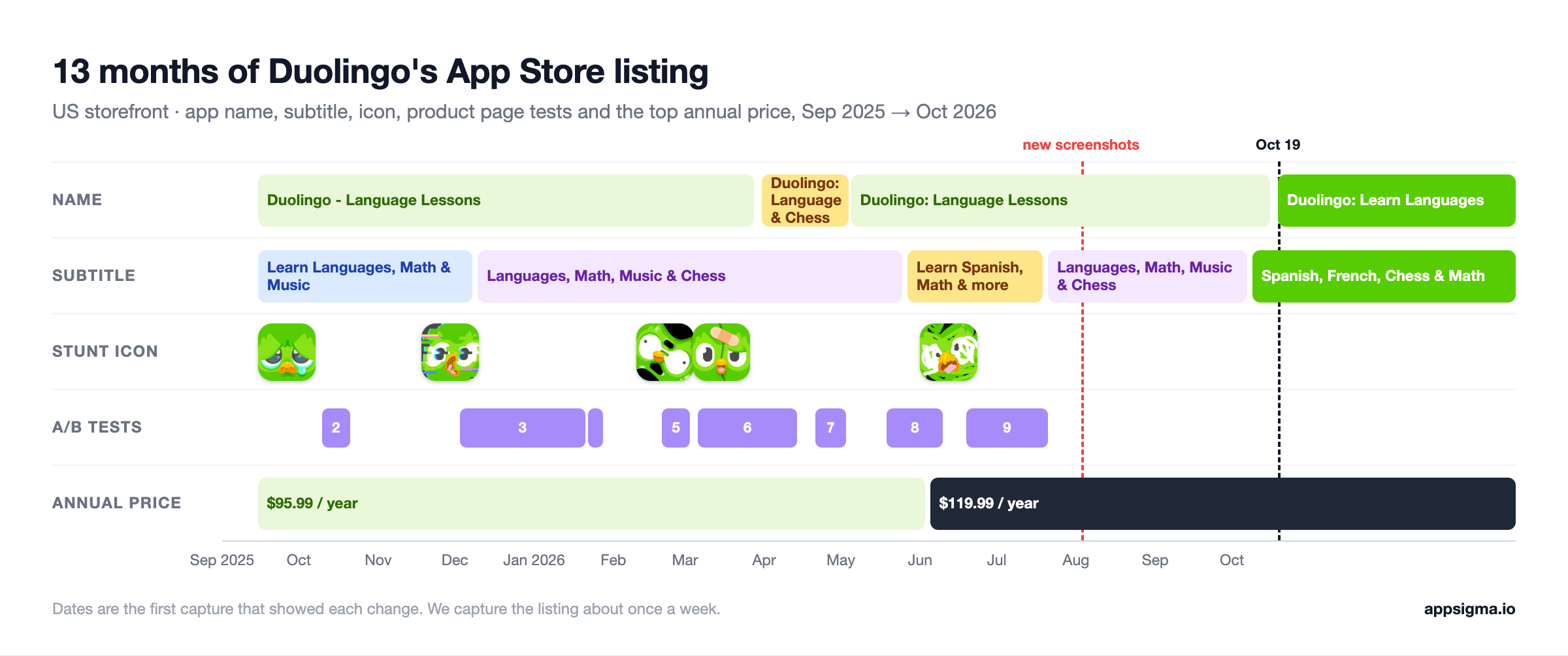
Chess was in the app name for five weeks
Duolingo launched chess in June 2025. The listing then moved chess forward one field at a time:
| Field | Value | Seen |
|---|---|---|
| Name | Duolingo - Language Lessons | Sep 15, 2025 → Mar 24, 2026 |
| Name | Duolingo: Language & Chess | Mar 31 → May 3, 2026 |
| Name | Duolingo: Language Lessons | May 5 → Oct 12, 2026 |
| Name | Duolingo: Learn Languages | Oct 19, 2026 (live page) |
| Subtitle | Learn Languages, Math & Music | Sep 15 → Nov 18, 2025 |
| Subtitle | Languages, Math, Music & Chess | Dec 10, 2025 → May 21, 2026 |
| Subtitle | Learn Spanish, Math & more | May 27 → Jul 21, 2026 |
| Subtitle | Languages, Math, Music & Chess | Jul 21 → Oct 8, 2026 |
| Subtitle | Spanish, French, Chess & Math | first seen Oct 9, live on Oct 19 |
Chess went into the subtitle in December and into the app name at the end of March. The name lasted five weeks. Duolingo went back to "Language Lessons" but kept the colon from the chess version, so the brand and the keywords now read as two parts: "Duolingo:" and then the description.
The subtitle went the other way. In late May it changed to "Learn Spanish, Math & more", the first version to name a single language. That held for eight weeks. On July 21 the December subtitle came back. The newest one, "Spanish, French, Chess & Math", names two languages and keeps chess. The name on October 19, "Learn Languages", is the closest to a plain search phrase of the four.
The app name and subtitle are the two text fields that App Store search reads first, together with the hidden keyword field. A name change is a ranking change too, as our guide to search position tracking explains. Four names in 13 months shows that Duolingo treats these fields as fields to test, not as a brand that is fixed.
Five stunt icons, then back to the owl each time
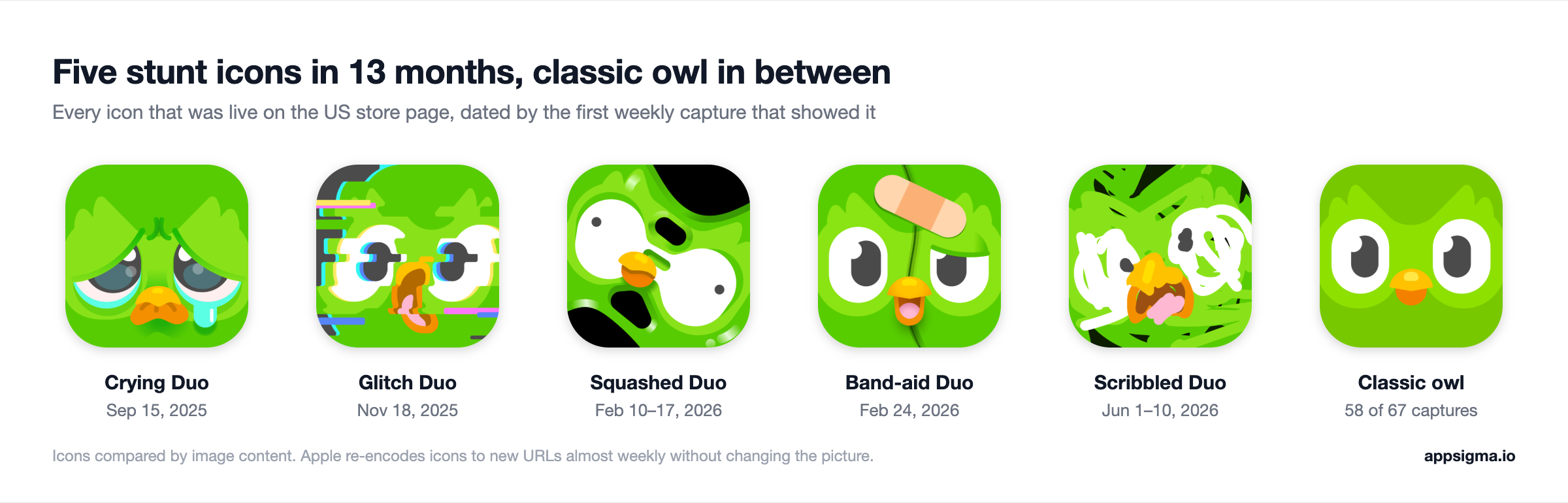
The classic green owl was the icon in 58 of our 67 captures. The other 9 captures showed one of five stunt icons:
| Icon | Seen |
|---|---|
| Crying Duo | Sep 15, 2025 |
| Glitch Duo | Nov 18, 2025 |
| Squashed Duo | Feb 10 → Feb 17, 2026 |
| Band-aid Duo | Feb 24, 2026 |
| Scribbled Duo | Jun 1 → Jun 10, 2026 |
Each stunt icon was live for about one to two weeks, and every time the classic owl came back. Duolingo has done this on social media for years, and the store icon is now part of the same campaigns. A sad or hurt mascot on your home screen is a reminder to open the app, without a push notification.
To find these, we had to compare the icon images, not their URLs. Apple re-encodes app icons to a new URL almost every week without changing the picture. If you count URL changes, Duolingo appears to change its icon every week.
9 A/B tests, one live on 61% of days
Our detector found 9 Product Page Optimization tests on Duolingo's US page. All of them changed screenshots. None changed the promotional text.
| # | Live | Days | Variants | What changed |
|---|---|---|---|---|
| 1 | Aug 24 → Aug 26, 2025 | 3 | 2 | First screenshot |
| 2 | Oct 10 → Oct 21, 2025 | 12 | 1 | Order of the first two screenshots |
| 3 | Dec 3, 2025 → Jan 21, 2026 | 50 | 3 | Second screenshot |
| 4 | Jan 22 → Jan 28, 2026 | 7 | 3 | Second screenshot |
| 5 | Feb 20 → Mar 3, 2026 | 12 | 3 | Second screenshot |
| 6 | Mar 6 → Apr 14, 2026 | 40 | 2 | Full new 8-screenshot sets |
| 7 | Apr 21 → May 3, 2026 | 13 | 3 | Full new sets: green Duo hero, three caption layouts |
| 8 | May 19 → Jun 10, 2026 | 23 | 2 | First screenshot: course list |
| 9 | Jun 19 → Jul 21, 2026 | 33 | 2 | First screenshot: course list, run again |
Between September 15, 2025 and July 21, 2026, a test was live on 190 of 309 days. When one test ended, the next usually started within a week. The median test ran 13 days. In our study of 53,000 App Store experiments, the median for the whole store was 11 days (8 for top-grossing casino apps), so Duolingo tests at about the same speed as everyone else. The difference is that it never stopped.
Since July 21 we have not detected a test. This does not prove that Duolingo stopped testing. Our crawl sees a test only when Apple serves a variant to one of our sessions.
The winning screenshots shipped on August 3
From at least September 2025 to July 21, 2026, Duolingo's page showed the same 10 screenshots. The only edit was on December 10, when the second and third screenshots got new captions. On the second one, "the fastest way" became "the fun way". On the third, "quick, fun bite-sized lessons" became "quick, bite-sized lessons".
By August 3 the page had 8 new screenshots. Their file names connect them to the tests:
- The first screenshot has the file name
first_screen_adapt_Var_2, from variant 2 of test 9. - Screenshots 2 to 8 are named
V2_iOS6.5_02toV2_iOS6.5_08, from variant 2 of test 7.
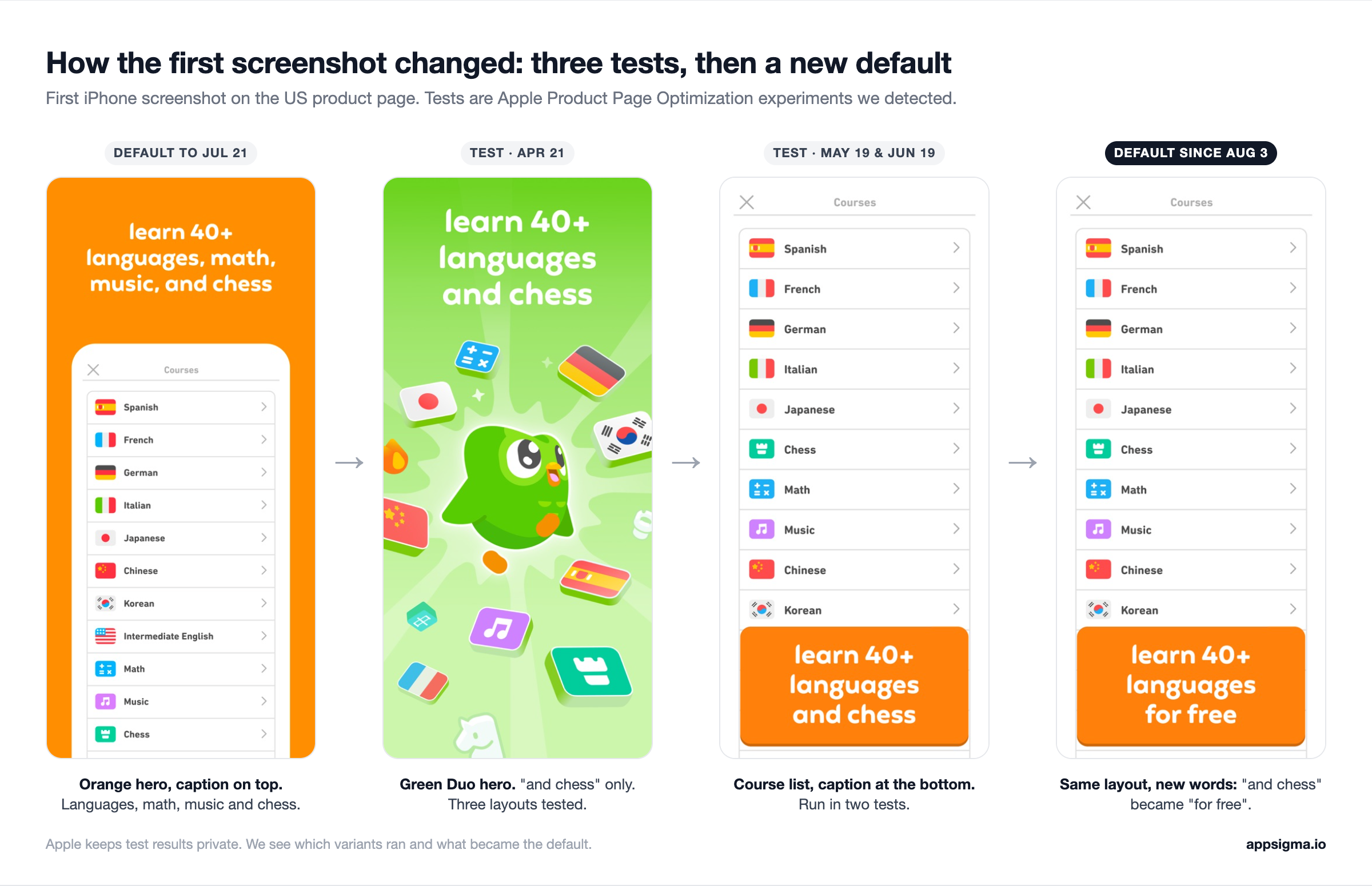
So the shipped page combines two winners from two different tests. The first screenshot is the course list with the caption at the bottom, which Duolingo tested in May and again in June. The rest of the set uses the April test layout, with the caption in a colored block under each screen.
One change on the shipped first screenshot was not in any variant we saw. Both course-list variants said "learn 40+ languages and chess". The live version says "learn 40+ languages for free". Three months after chess left the app name, it also left the main caption, and "free" took its place.
Apple keeps PPO results private, so we cannot see the conversion numbers. What we can see is which variants ran, for how long, and which one became the default. For Duolingo, the course-list layout ran in two tests over 56 days and then became the default.
Release notes say nothing, in-app events say everything
Duolingo shipped 75 versions between September 15, 2025 and October 19, 2026, about 1.3 per week. All 75 release notes are the same joke about Duo eating bugs instead of mice, in two wordings. You cannot learn what changed in the app from them.
The in-app events in the App Store tell the real story. We recorded 18 events that started in the same period, including:
| Event | Start |
|---|---|
| Your Year in Review is here | Dec 2, 2025 |
| Explain My Answer is here | Jan 5, 2026 |
| Learn Spanish before halftime | Jan 19, 2026 |
| Practice is now for everyone | Mar 18, 2026 |
| Play your friends in chess | Mar 23, 2026 |
| Math made fun for every level | May 8, 2026 |
| Learn first, scroll later | May 25, 2026 |
| Review your chess matches | Sep 1, 2026 |
| The Brawl Stars Quest is here! | Sep 19, 2026 |
Some events ran only in other storefronts, with their own language: Russian in May and June, Korean in June, and Chinese (for the Cantonese course) in July. The listing also added Apple Vision Pro support on May 27, 2026. If you track a competitor that writes empty release notes, read its in-app events instead.
The top listed annual price is now $119.99
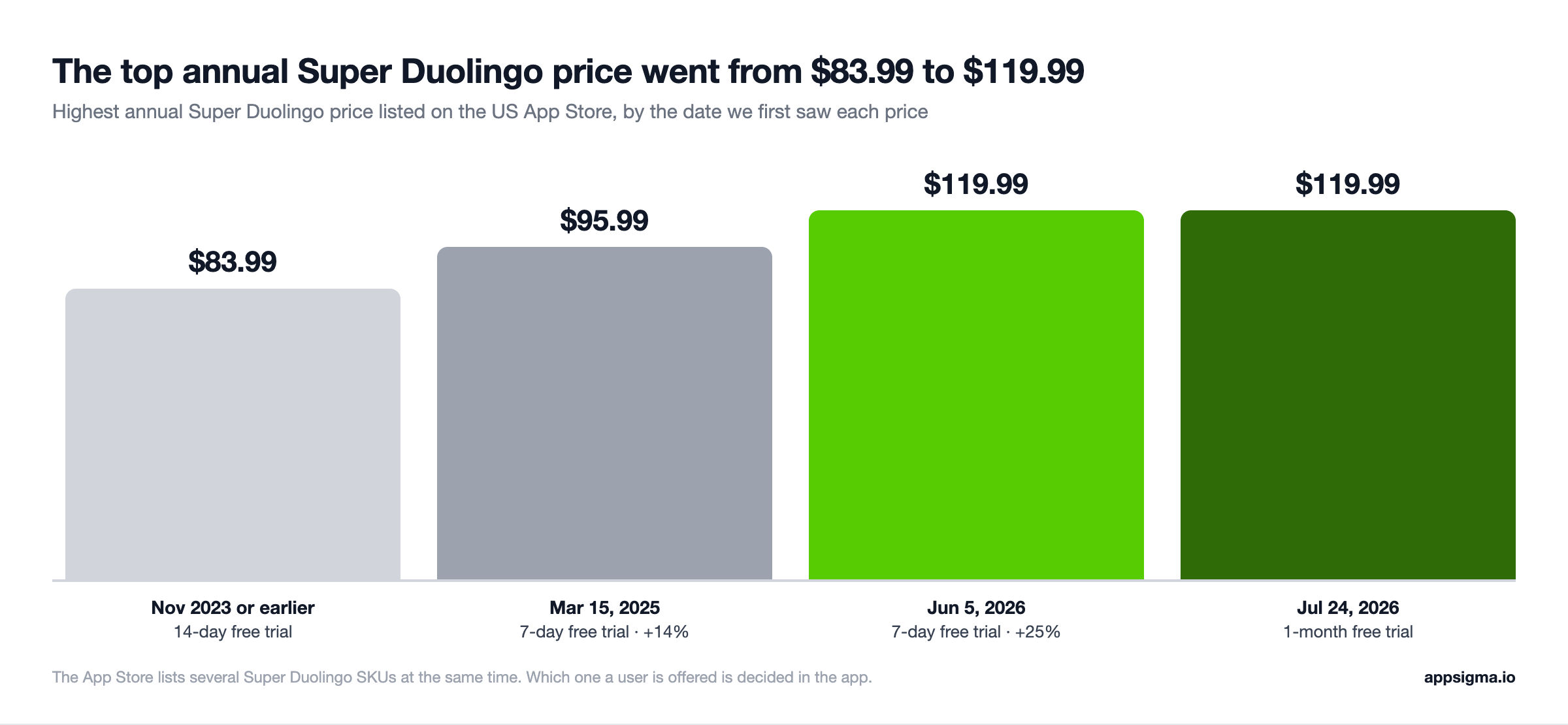
The App Store shows the in-app purchases of an app, and Duolingo lists many Super Duolingo subscriptions at the same time. On October 19 the US page listed annual plans at $59.99, $79.99, $83.99, $95.99 and $119.99, and monthly plans at $9.99 and $12.99. The app decides which one a user is offered. Vertical drama apps do the same with weekly plans: DramaBox lists three first-week prices for one membership.
The most expensive annual plan tells you the direction:
| First seen | Top annual price | Free trial |
|---|---|---|
| Nov 2023 or earlier | $83.99 | 14 days |
| Mar 15, 2025 | $95.99 | 7 days |
| Jun 5, 2026 | $119.99 | 7 days |
| Jul 24, 2026 | $119.99 | 1 month |
The $119.99 plan is 25% above $95.99 and 43% above $83.99. The trial got shorter when the price went up in 2025, and longer again seven weeks after the 2026 increase: a month at $119.99 in place of a week. The App Store description on October 19 still offers "Super Duolingo for 14 days free", a trial length that none of the newer annual plans use.
What to take from Duolingo's listing
- The name and subtitle are not fixed. Duolingo used four names and four subtitles in 13 months. Big brands test search text too.
- Test without stopping. A test was live on 61% of days, and the shipped screenshots come from two different winning variants.
- Edit the winner before you ship it. The live caption says "for free", a phrase that was not in either course-list variant we saw.
- The icon is a campaign channel. Five stunt icons, each live for one or two weeks, and then back to the classic owl.
- Read in-app events, not release notes. 75 identical release notes, but 18 events that name the real features.
The same kind of tests are visible on any app. We showed another case in the Keiki keyword field study, where a kids app finished its screenshot tests before it changed its keywords. AppSigma records listing changes, A/B tests and in-app events for the apps you track, so you can see what your competitors change and when.
Method notes: 67 weekly captures of the US listing plus one read of the live page on October 19. One capture on July 27, 2026 returned the Russian localization and is excluded. Icons are compared by image content. Experiments are Product Page Optimization tests detected on the US storefront in the en-US locale. We can miss a test that ends between two of our crawls. Prices are US dollar subscriptions. Rows in other currencies that appear in the US data are excluded.
Frequently asked questions
How often does Duolingo change its App Store listing?
Very often for an app of its size. In 13 months the US page went through four names, four subtitles and five temporary mascot icons, and one complete screenshot redesign in early August 2026.
Does Duolingo A/B test its App Store page?
Yes, almost all year. Our detector logged nine Product Page Optimization experiments, every one of them on screenshots. From mid-September 2025 to late July 2026, roughly three days out of five had an experiment running, with a typical length of about two weeks.
How much does Super Duolingo cost on the App Store?
It depends on the plan the app offers you. The US store lists yearly plans from $59.99 up to $119.99 and monthly plans of $9.99 and $12.99. The $119.99 yearly plan first appeared in June 2026, replacing $95.99 as the highest yearly price.